BERT — Bidirectional Encoder Representations from Transformers
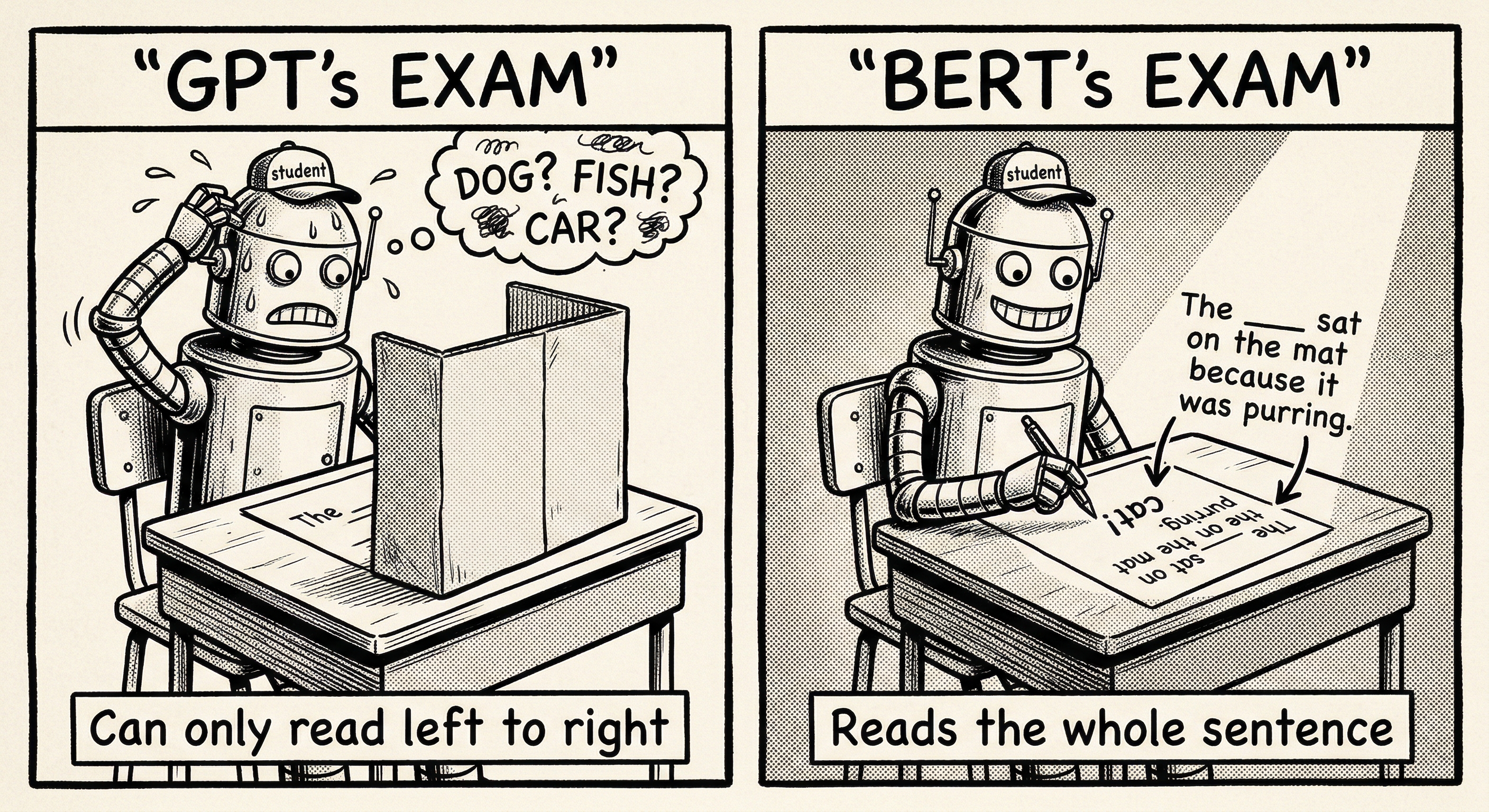
You’ll learn why bidirectional attention makes BERT strong at understanding tasks, and how Masked Language Modeling trains it to use both left and right context. You’ll also see how the [CLS] token, fine-tuning, and BERT’s contrast with GPT fit together.
See the Difference: BERT vs GPT
Click any word to mask it. Compare how a model that sees the whole sentence (BERT) vs. one that sees only what came before (GPT) predicts the masked word:
Masked Language Modeling
What to look for:
- Mask a word in the middle of the sentence — BERT uses both sides, GPT can only use the left
- Mask the last word — both models perform similarly (no right context to use)
- Notice how much BERT’s predictions improve when right context is informative
Why Looking Both Ways Matters
Try masking “mat” in the sentence above. With only left context (“The cat sat on the”), you might guess “mat”, “floor”, or “chair.” But with right context too (“because it was dirty”), “mat” becomes much more likely — you need both sides!
BERT’s innovation: bidirectional attention. Every token sees every other token — no causal mask. This makes it powerful for understanding tasks, where you have the full input available.
Architecture
BERT is simply the encoder stack from the original Transformer — no decoder, no causal masking:
| Stage | What Happens |
|---|---|
| Input | [CLS] + tokens + [SEP] |
| Embedding | Token + Position + Segment embeddings |
| Encoder | 12 (or 24) bidirectional self-attention layers |
| Output | Contextualized representation per token |
| Model | Layers | Hidden | Heads | Parameters |
|---|---|---|---|---|
| BERT-base | 12 | 768 | 12 | 110M |
| BERT-large | 24 | 1024 | 16 | 340M |
Pre-training: Masked Language Modeling (MLM)
BERT’s training objective: randomly mask 15% of tokens, then predict the originals. Let’s trace through a concrete example.
Input: "The [MASK] sat on the mat" (we masked “cat”)
BERT embeds each token, adds positional encodings, and runs 12 bidirectional attention layers. Because attention is bidirectional, the [MASK] position attends to all other tokens — “The”, “sat”, “on”, “the”, “mat.” By the final layer, the representation at position 2 encodes rich context from both sides. This is projected to vocabulary logits (30,522 scores), and softmax assigns probabilities: maybe “cat” gets 0.67, “dog” gets 0.12, “bird” gets 0.08. The loss is −log(0.67) ≈ 0.4, and gradients flow back to improve the representations.
The 80/10/10 Strategy
Of the 15% selected tokens:
| Treatment | Percentage | Example |
|---|---|---|
Replace with [MASK] | 80% | “The [MASK] sat on the mat” |
| Replace with random word | 10% | “The banana sat on the mat” |
| Leave unchanged | 10% | “The cat sat on the mat” |
Next Sentence Prediction (NSP)
MLM teaches BERT about token-level context, but many downstream tasks involve comparing sentences — “Is this passage relevant to this question?” or “Does sentence A contradict sentence B?” BERT’s second pre-training objective tackles this: given two sentences, predict whether the second actually follows the first in the original text.
| Input | Label |
|---|---|
[CLS] “The cat sat on the mat” [SEP] “It was purring softly” | IsNext |
[CLS] “The cat sat on the mat” [SEP] “Stock prices rose sharply” | NotNext |
The [CLS] token’s representation is used for this binary classification. This teaches BERT about sentence-level relationships — useful for tasks like question answering and natural language inference.
Note: Later work (RoBERTa) showed that NSP may not actually help much. RoBERTa removes it entirely and trains better. But understanding NSP helps explain BERT’s original design choices, especially the
[CLS]and[SEP]tokens.
The [CLS] Token
BERT prepends a special [CLS] token to every input. Its final representation acts as a sentence-level summary:
Because [CLS] attends to all other tokens via self-attention, it aggregates information from the entire sentence — perfect for classification tasks.
Fine-tuning BERT
BERT follows a two-stage paradigm:
Stage 1: Pre-train on massive unlabeled text (MLM objective)
Stage 2: Fine-tune on a small labeled dataset for your specific task
| Task | Input | Output From | Example |
|---|---|---|---|
| Sentiment | Single sentence | [CLS] | “Great movie!” → Positive |
| NER | Single sentence | Each token | ”Alice went to Paris” → PER, O, O, LOC |
| Q&A | Question + Passage | Each token | Find start/end of answer span |
| Similarity | Two sentences | [CLS] | “I like cats” ≈ “Cats are great” |
BERT vs GPT
| Aspect | BERT | GPT |
|---|---|---|
| Architecture | Encoder-only | Decoder-only |
| Attention | Bidirectional (sees all) | Causal (sees only left) |
| Pre-training | Masked LM (fill in blanks) | Next token prediction |
| Strength | Understanding tasks | Generation tasks |
| Can generate? | Not directly | Yes, autoregressively |
The Practical Impact
BERT dominated NLP benchmarks from 2018-2020. But the tide shifted:
- GPT-3 (2020) showed that large decoder-only models can do understanding tasks too — via in-context learning
- Modern LLMs (GPT-4, Claude, LLaMA) are all decoder-only but handle both understanding and generation
BERT-style models remain useful for:
- Efficient classification and search (smaller, faster)
- Sentence embeddings (e.g., all-MiniLM, E5)
- Token-level tasks like NER
Quick Summary
| Concept | What Happens | Intuition |
|---|---|---|
| Bidirectional attention | Every token attends to every other token — no causal mask | Like reading a whole sentence before filling in a blank, not guessing word by word |
| Masked Language Modeling | 15% of tokens are masked; BERT predicts the originals | A fill-in-the-blank exam that forces deep contextual understanding |
| 80/10/10 strategy | Masked tokens are replaced with [MASK] (80%), random words (10%), or kept (10%) | Prevents BERT from only learning to “spot the [MASK] token” |
| [CLS] token | Special token whose final representation summarizes the whole input | An attentive reader who listens to every word and writes a summary |
| Fine-tuning | Pre-trained BERT is adapted to specific tasks with a small labeled dataset | A well-read student who quickly learns a new subject |
| Encoder-only | No decoder, no autoregressive generation | Built for understanding, not for writing |
- I can explain why bidirectional attention helps understanding tasks but prevents autoregressive generation
- I understand BERT’s Masked Language Modeling objective and the 80/10/10 masking strategy
- I can describe how the [CLS] token aggregates sentence-level information through self-attention
- I understand the pre-train then fine-tune paradigm and how BERT adapts to different downstream tasks
- I can compare BERT and GPT architecturally and explain when each approach is more appropriate
- I know why modern LLMs shifted toward decoder-only architectures despite BERT’s success
Next: GPT
While BERT excels at understanding, GPT excels at generation. Next: GPT — Decoder-Only Transformers →