GPT — Generative Pre-trained Transformer
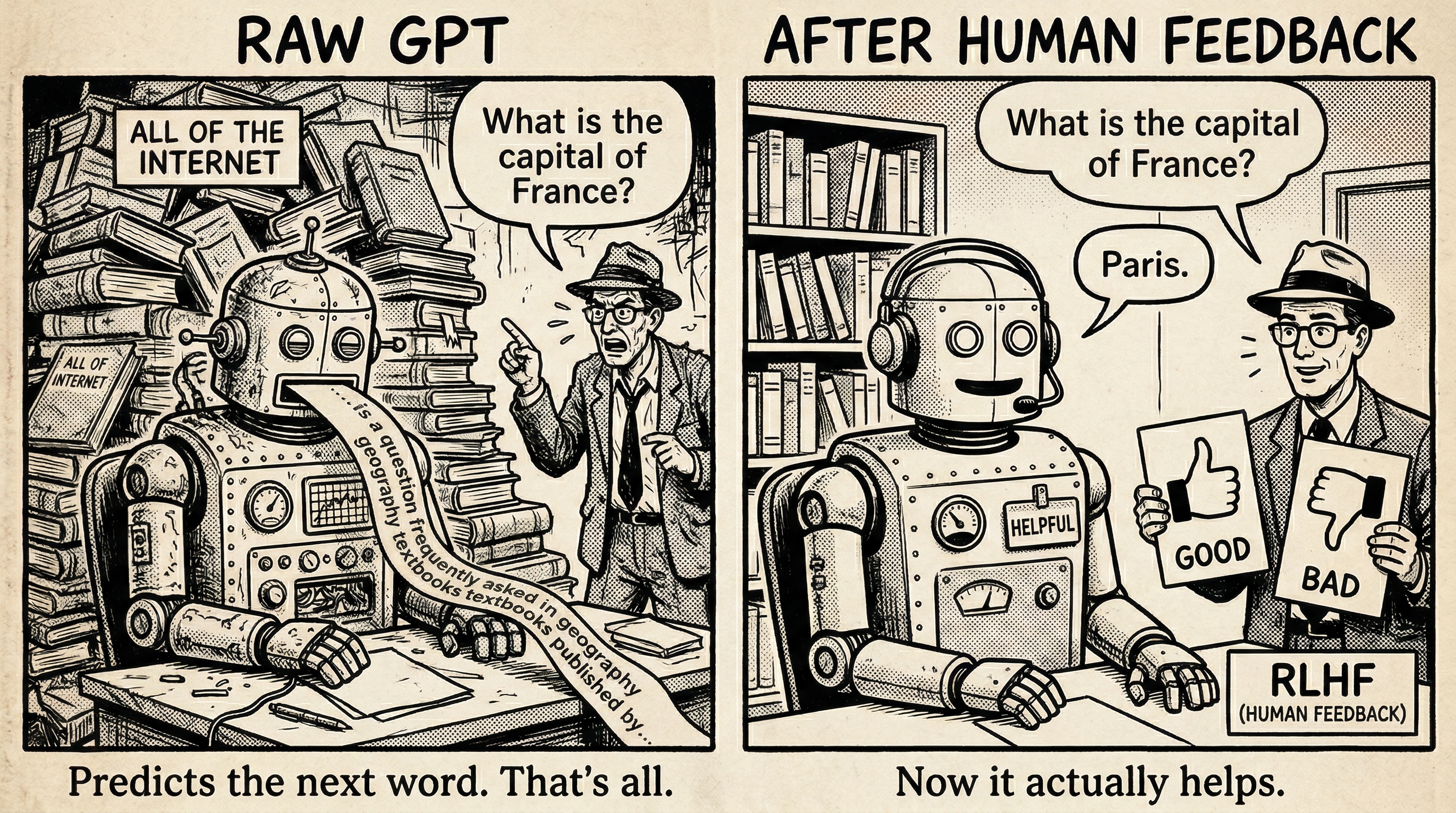
You’ll learn how GPT uses next-token prediction to generate text, and why scale makes that simple objective surprisingly powerful. You’ll also see how sampling controls, scaling laws, in-context learning, and RLHF shape raw prediction into useful assistant behavior.
The Big Idea: Just Predict the Next Word
GPT’s training objective is the simplest possible:
Given all previous tokens, predict the next one.
That’s it. No masking, no fill-in-the-blank, no special objectives. Just relentlessly predict the next token, billions of times, on massive text corpora.
The remarkable discovery: this simple objective, at sufficient scale, produces general intelligence.
Architecture
GPT is the decoder stack from the Transformer — with causal (masked) self-attention:
| Stage | What Happens |
|---|---|
| Input | Token sequence (e.g., “The cat sat on the”) |
| Embedding | Token + Position embeddings |
| Decoder layers | N layers of causal self-attention + FFN |
| Output projection | Hidden state → vocabulary probabilities |
| Prediction | Sample next token from distribution |
| Model | Year | Layers | d_model | Params | Context |
|---|---|---|---|---|---|
| GPT-1 | 2018 | 12 | 768 | 117M | 512 |
| GPT-2 | 2019 | 48 | 1600 | 1.5B | 1024 |
| GPT-3 | 2020 | 96 | 12288 | 175B | 2048 |
| GPT-4 | 2023 | ? | ? | ~1T? | 128K |
Interactive: Generation in Action
Experiment with autoregressive generation. Adjust temperature and top-k to see how sampling strategies change the output:
Autoregressive Generation
What to look for: Generate a few tokens at low temperature (0.1), then reset and try high temperature (2.0). Low temperature produces predictable, repetitive text. High temperature produces surprising, sometimes nonsensical text. Then experiment with top-k: setting it to 1 forces greedy decoding regardless of temperature.
Understanding the Controls
Temperature scales the logits before softmax — low temperature makes the model more deterministic, high temperature makes it more creative:
| Temperature | Distribution | Effect |
|---|---|---|
| T = 0.1 | Very peaked | Almost always picks the top token (deterministic) |
| T = 1.0 | Standard | Samples naturally from learned distribution |
| T = 2.0 | Flattened | More diverse, surprising choices |
Top-k limits sampling to the top k most likely tokens, filtering out low-probability noise.
Top-p (nucleus sampling) includes the smallest set of tokens whose cumulative probability exceeds . Unlike top-k which always considers the same number of tokens, top-p is adaptive — it considers fewer tokens when the model is confident and more when it’s uncertain.
| Context | Top-k (k=5) | Top-p (p=0.9) |
|---|---|---|
| “The capital of France is” | Always 5 tokens | Maybe 1-2 tokens (high confidence) |
| “I feel really” | Always 5 tokens | Maybe 10+ tokens (uncertain) |
This is why most production LLMs (including ChatGPT and Claude) use top-p rather than top-k.
Scaling Laws: More Compute = Better Model
GPT-3’s paper revealed that model performance follows predictable power laws. In plain terms: if you want a better model, just make it bigger, feed it more data, and give it more compute. The improvement is smooth and predictable — no guesswork needed.
| Factor | Practical Meaning |
|---|---|
| More parameters | 10x more params gives roughly 16% loss reduction |
| More data | 10x more data gives roughly 20% loss reduction |
| More compute | 10x more compute gives roughly 11% loss reduction |
Emergent Abilities
At certain scales, new capabilities appear suddenly — they’re nearly absent in smaller models:
| Ability | Appears Around | Example |
|---|---|---|
| Few-shot learning | ~1B params | Learning from examples in the prompt |
| Arithmetic | ~10B params | ”What is 47 × 83?” |
| Code generation | ~50B params | Writing working Python functions |
| Chain-of-thought | ~100B params | ”Let me think step by step…” |
| Self-correction | ~100B+ params | ”Wait, that’s wrong. Let me reconsider…” |
In-Context Learning: GPT’s Superpower
GPT-3’s most surprising ability: learning from examples in the prompt without updating weights.
| Prompting Style | Example |
|---|---|
| Zero-shot | ”Translate to French: Hello world” → “Bonjour le monde” |
| One-shot | ”Good morning → Bonjour” then “Hello world →” → “Bonjour le monde” |
| Few-shot | Multiple examples then query → model identifies the pattern |
The model doesn’t update its parameters — it uses the attention mechanism to identify the pattern in the prompt and apply it. This is a form of meta-learning that emerges at scale.
From GPT to ChatGPT: RLHF
Pre-trained GPT is a great text predictor but not a great assistant. Reinforcement Learning from Human Feedback (RLHF) bridges this gap:
| Step | Process | Result |
|---|---|---|
| 1 | Pre-train on text (next-token prediction) | Raw language model |
| 2 | Supervised fine-tuning (SFT) on conversations | Follows instructions |
| 3 | Train reward model from human preferences | Knows what “good” looks like |
| 4 | Optimize with PPO/DPO using reward model | Helpful, harmless, honest |
This process transforms a raw text predictor into ChatGPT, Claude, or other chat models.
Quick Summary
| Concept | Details |
|---|---|
| Architecture | Decoder-only transformer with causal masking |
| Training | Next-token prediction on massive text |
| Key innovation | Scale + simple objective = general intelligence |
| Sampling | Temperature, top-k, top-p control generation diversity |
| Emergent abilities | Few-shot learning, reasoning, code generation |
| RLHF | Aligns raw LLM with human preferences |
- I can explain GPT’s next-token prediction objective and why it produces general capabilities at scale
- I understand how temperature, top-k, and top-p control generation diversity and can describe the tradeoffs
- I can describe scaling laws and why bigger models with more data reliably improve
- I understand in-context learning (zero-shot, one-shot, few-shot) and that no weights are updated during it
- I can explain the RLHF pipeline that transforms a raw language model into a helpful assistant
- I can compare GPT and BERT architecturally and explain why modern LLMs are decoder-only
Next: An Optional Training Lab, Then Agents
Use the training loop you learned to adapt an existing model in Fine-tune an Open Model (Optional) →. The lab starts with pretrained weights and saves a small LoRA adapter.
You can also continue directly to LLM Agents →, where a language model becomes part of a loop that calls tools and responds to their results.